

If you have a middle-sized lawn of about 1 acre, a riding mower will save you a lot of time compared to using a push mower. This guide breaks down exactly what you need for a 1-acre property, which brands and features are worth paying for, and which specific models give you the best value.
Key Components Explained (What Actually Matters)
You don’t need to become a small engine mechanic to buy the right mower for your 1-acre property. You just need to understand the five or six components that actually make a difference in how well this machine cuts your grass and how long it’ll last.
Let me walk you through what matters and what’s just marketing fluff.
The Engine: Your Mower’s Heart
The engine is where most people overthink things. You’ll see riding mowers advertised with anywhere from 15 to 24 horsepower, and it’s tempting to think bigger is always better.
For a flat 1-acre property, you’re looking at 18 to 22 HP as the sweet spot. Anything less and you’ll bog down in thick spring growth. Anything more and you’re just burning extra fuel for no real benefit.
Kawasaki engines are the gold standard. They’re smooth, they last forever (I’m talking 1,500+ hours if you maintain them), and they start reliably even after sitting all winter. You’ll pay $200 to $400 more for a Kawasaki, but it’s worth every penny if you plan to keep this mower for 10+ years.
I usually tell people to avoid mowers with no-name Chinese engines. Parts availability is sketchy, and reliability is hit or miss.
One more thing on engines: displacement matters more than horsepower for cutting thick grass. Look for 400 to 700 cc on the spec sheet. Higher cc means more torque, which is what you need when you hit a thick patch of overgrown grass.
Transmission: The Part That Breaks (Or Doesn’t)
The transmission is what takes power from your engine and delivers it to the wheels, and it’s also the most common failure point on riding mowers.
Hydrostatic transmission is what you want for a 1-acre property. Period. It’s controlled by a foot pedal or hand lever, gives you variable speed control, and makes mowing feel effortless. No jerky gear changes, no clutch to wear out.
A reality check: repairing a failed hydrostatic transmission costs $800 to $1,500. On a $2,000 mower, that’s basically a total loss after 5 or 6 years. On a $3,500 mower with a commercial-grade hydrostatic system, you’re looking at 15+ years of reliable service.
Maintenance tip: hydrostatic fluid should be changed every 200 hours or annually, whichever comes first. Most people never do this, and that’s why transmissions fail prematurely.
| Transmission Type | Lifespan (Hours) | Repair Cost | Best For |
|---|---|---|---|
| Hydrostatic (Quality) | 600-1,000 | $800-1,500 | 1-acre properties, easy operation |
| Hydrostatic (Budget) | 400-600 | $800-1,500 | Tight budgets (risk of early failure) |
| Manual/Gear Drive | 1,000+ | $200-400 | Simple rectangular yards, budget-conscious |
| Automatic (Belt) | 600-800 | $300-600 | Middle ground option |
Cutting Deck: Where Cheap Construction Shows Up Fast
The cutting deck is the big metal shell that houses your blades. It’s also where manufacturers love to cut corners on budget mowers.
Stamped steel decks are what you’ll find on most mowers under $2,500. They’re made from a single sheet of 12-gauge or 13-gauge steel that’s pressed into shape. They work fine, but they’ll rust through in 10 to 15 years, especially if you leave clippings stuck to the underside.
Fabricated steel decks are welded together from multiple pieces of thicker 10-gauge steel. They’re heavier, more expensive (add $300 to $500 to the mower price), and they’ll outlast the rest of the mower. If you plan to keep this machine for 20+ years, fabricated is worth it.
For 1-acre properties, deck width is your next consideration. Here’s how I think about it:
- 42-inch deck: Adequate but slow. You’ll spend 50 to 60 minutes mowing. Good if you have lots of tight spaces.
- 46-inch deck: The sweet spot for most 1-acre properties. Mowing time drops to 40 to 50 minutes. Fits through most gates.
- 48-inch deck: Maximum efficiency without overkill. You’ll finish in 35 to 45 minutes. Make sure it fits your gates first.
- 50-inch and larger: Overkill unless you’ve got wide-open space with zero obstacles.
One thing to check: does the deck have a wash port? It’s a simple hose connection that lets you clean the underside without crawling under the mower. Sounds minor, but keeping your deck clean prevents rust and maintains cutting performance. I use mine after every third or fourth mow.
What You Can Skip (And Save Money)
Here’s where you can save money without sacrificing performance.
Power steering sounds great but adds $400 to $600 to the price. For 1-acre, you don’t need it.
LED headlights are nice if you mow early morning or late evening, but basic halogen lights work fine and cost $100 less.
Cruise control is a gimmick on residential mowers. You’re constantly adjusting speed around obstacles. Save the $75 to $150 and skip it.
Hour meters are genuinely useful for tracking maintenance, but you can add an aftermarket one for $20 to $40 if your mower doesn’t include it. Don’t pay extra for a built-in one.
FINAL DECISION FRAMEWORK
5 questions to narrow your options
I’m going to walk you through five questions that’ll cut through the noise. Answer these honestly, and you’ll know exactly which type of mower you need and which ones you can cross off your list entirely.
> Question 1: What’s Your Property Shape and Obstacle Situation?
Here’s what I mean. Pull up a satellite view of your property on Google Maps right now. Really, do it. Look at the shape of your lawn and count the obstacles.
If your yard is mostly rectangular with minimal obstacles (a few trees, maybe a flower bed or two), you’re in the traditional riding mower category. A 42 to 46 inch deck will handle this beautifully, and you’ll spend $2,000 to $3,000 for a quality setup.
If your property is irregular shaped with lots of trees, shrubs, and landscape features, you need to think seriously about maneuverability. You’ll either want a smaller 42 inch traditional mower that can navigate tighter spaces, or you’ll want to consider a zero-turn if your budget allows and your property is relatively flat.
> Question 2: Do You Have Any Slopes Over 10 Degrees?
This question is about safety, not performance.
Here’s how to check your slope angle. Download a free inclinometer app on your phone. Walk to the steepest part of your property and measure it. Anything over 10 degrees is zero-turn danger territory.
Zero-turn mowers have a rear-heavy weight distribution because of their dual hydrostatic transmissions. On slopes over 10 degrees, they become unstable and can roll. I’m not exaggerating. People get hurt every year trying to mow slopes that are too steep with zero-turns.
Traditional riding mowers with front engines handle slopes up to 15 degrees safely.
> Question 3: What’s Your Real Budget (Including 5-Year Ownership)?
I’m not asking what you want to spend. I’m asking what you can realistically invest in when you factor in the total cost of ownership.
Here’s the framework I use. Take your purchase budget and add roughly 20% for five years of maintenance. So a $2,500 mower will cost you about $3,000 total over five years when you include oil changes, blades, belts, and filters.
Be honest about resale value too. If you think you might move in 5 to 7 years, a John Deere holds 55% to 60% of its value. A generic brand might hold 30% to 35%. That difference can be $600 to $800 in your pocket later.
> Question 4: What Features Actually Matter to You?
Start with comfort because you’ll be sitting on this thing for 40 to 60 minutes every week. A high-back seat with decent padding matters. Cruise control for straightaways matters. Cup holders and armrests matter if you’re doing a full acre in the summer heat.
Then think about your specific situation. Do you mow early morning or late evening? You’ll use headlights constantly, so LED upgrades are worth it. Do you have a lot of fallen leaves? A mulching kit ($100 to $150) saves you from buying a $400 bagger.
> Question 5: How Long Do You Plan to Keep This Mower?
If you’re planning to move within 5 years, focus on resale value and buy a brand with strong name recognition. John Deere, Cub Cadet, and Husqvarna all hold value better than Craftsman or Troy-Bilt.If this is your forever home and you’ll keep this mower until it dies, the calculation shifts toward total cost of ownership. A $3,200 mower that lasts 20 years costs you $160 per year. A $1,800 mower that lasts 10 years costs you $180 per year. The more expensive one is actually cheaper in the long run.
I believe that all these listed below will give you performance for a very long time. With the range of options available in these ridable mowers, it is important that you know what to look for to make the right pick for you. In this guide, I’ll check out the best riding mowers for medium-sized lawns.
The Best Mowers
The Husqvarna Z246 has been my go-to mower for 1 year now. Great for 1 Acre, smaller and larger. My lot is just over 1 acre and it’s comfortable, has good performance, and doing maint on it so far has been on the easier side. Plus Husqvarna makes one of the best riding mowers on the market today.
Husqvarna Z246 zero turn riding mower

The Husqvarna Z246 zero-turn riding mower is built for power, and it will consistently deliver a satisfactory output for people who are looking to get their mowing done thoroughly. I only used this one time but was really impressed with the maneuverability and performance of this unit. The cut was really nice as well.
With rear traction boosts for added control and an optimized layout, this model will allow very comfortable use even for people with relatively short experience.
It is a maintenance-free zero-turn mower that will ensure you make much fewer passes on your lawn than you might with other mowers. Its 26 HP engine and reinforced steel frame should guarantee the excellence of its output.
Pros
- Very powerful output
- Tough and durable build
- Easy to use
- Impressive cutting width
Cons
- Not the most fuel-efficient

[amazon box=”B085RHTWX3″ template=”horizontal”]
Ariens IKON-XD 42″ zero turn riding mower

Made with tough 10-gauge tubular steel, the Ariens IKON-XD zero-turn riding mower is one of the most durable models on this list. I got to try out this bad boy last summer when a neighbor picked one up and I got to mow his lawn for free. I liked the mower but it took some time to get used to as I was more familiar with Husqvarna units. But overall this is a solid machine and I can see why they are getting more popular.
The mower will handle your heavy-duty lawn without a problem, and may even improve your mowing efficiency on obstacle-filled and problematic turfs. This model features a large cutting width, adjustable cutting height, and a comfortable seating arrangement that includes an armrest as well.
The high-performance model will guarantee efficient service over your 1-acre yard and will deliver sustained output with consistent use.
Pros
- Powerful engine
- Good cutting width
- Comfortable, padded seat with armrests
- Durable model
Cons
- Handle bolts can be problematic if not installed securely

[amazon box=”B08563QWLX” template=”horizontal”]
Husqvarna TS354 XD 54″ Tractor Mower Review

The Husqvarna TX354XD tractor mower is our first of three riding mowers by the trustworthy brand. I used to use only Husqvarna equipment, that was until I started this site. Now I get the chance to try many models and brands and Husqvarna typically stands on the top of my lists.
This model delivers a great performance throughout the year and guarantees a very powerful output each time.
Most of the power of the 24 HP engine in the mower is directed towards cutting, facilitating a thorough cut even on the toughest lawns.
While it may struggle on steep slopes, it works well with all manner of heavy-duty mowing. The model is very easy to control, thanks to an ergonomic steering wheel and a simple layout for all key features.
The wide cutting surface and reinforced body should ensure consistent and convenient cutting throughout the year. It also needs minimal maintenance, guaranteeing extended hassle-free use. It is also compatible with the installation of other gardening equipment such as dump carts, aerators, etc.., making it an ideal pick for a number of tasks.
Pros
- Powerful performer
- Sufficient cutting width
- Easy to start and use
- Very durable build
Cons
- Not ideal for steep hills

[amazon box=”B087ZRH97R” template=”horizontal”]
Craftsman R105 single-engine gas-powered riding mower

The Craftsman R105 single-engine gas-powered riding mower might be one of our smallest options, but it is a great pick. This was the very first model I owned when I worked in the lawn & garden department at a Sears in south Florida.
This single-engine mower makes use of a 382 cc high power engine to deliver an efficient cut for most middle-size lawns. The model is sturdy but lightweight, thanks to its compact design. It is very easy to use and is responsive to steering.
It does not offer as much versatility as other models featured but it will get the job done. It also features a very comfortable seat, which can be adjusted for easier use.
Pros
- Powerful output belies its size
- Light and easy to store
- Very well designed
Cons
- Smaller cutting width
- Not as powerful as other models featured
[amazon box=”B07NW8RR7F” template=”horizontal”]
Husqvarna YTH18542 riding mower

The Husqvarna YTH18542 riding mower is a high-end riding mower that is powerful and user-friendly. This model is ideal for both small and large-scale mowing in a variety of environments. The mower is very easy to use and features the most friendly control interface.
It is a minimal maintenance option that will start at the turn of your key, and provide a powerful performance backed by an 18.5 HP engine. The mower also features a wide cutting deck that should help you cover your lawn in minimal time.
Thanks to the adjustable and heavily padded seat, you will be able to stay comfortable throughout your mowing as well. It is also designed for durability, with reinforced components and a sturdy steel frame.
Pros
- Very easy to control
- Sufficient cutting width
- Comfortable and ergonomic design
- Impressive output from 18.5 HP engine
Cons
- Not the biggest fuel capacity
[amazon box=”B07D6XH8KR” template=”horizontal”]
Husqvarna MZ61 Zero turn riding mower

The Husqvarna MZ61 Zero-turn riding mower is a great option for 1-acre lawns because it delivers a highly efficient performance. The model’s 3-blade system will make it very easy to keep your lawn trim with as few passes as possible.
It is a sturdy option with a fortified frame that should last for a long time. The riding mower also features very comfortable steering thanks to an intuitive layout and padded handles for a better grip.
You will also stay up to date with the mowers servicing needs, thanks to its advanced display meter that indicates any need for servicing. The removable foot pan will offer easy access in the event of clean-up or maintenance of your mower for longer life.
Pros
- Widest cutting deck for any model we’ve featured
- Powerful output and includes 3-blade system
- Easy to control
- Minimal maintenance mower
Cons
- Only a single-point adjustable height
[amazon box=”B00IE6Z0PW” template=”horizontal”]
Troy-Bilt Mustang zero turn riding mower

The powerful Troy-Bilt Mustang zero-turn riding mower features a 25HP engine, which will ensure a satisfactory output for medium to large lawns. It is very easy to control and will deliver an impressive cutting width.
Thanks to the adjustable cutting height, this mower allows you to make as few passes as possible by setting up your grass level for your mowing needs. It also features a convenient fuel gauge that allows you to monitor the amount left, but it should hold a decent capacity to get you through a large mowing session without needing any refueling stops.
It is a guaranteed comfortable ride, thanks to the padded high back seat with twin suspension springs for maximum comfort when riding.
Pros
- Rear roller for added efficiency
- Large cutting width
- Easy to maintain
- Very powerful engine
Cons
- Not the most efficient fuel consumption rate
Troy-Bilt Pony 42 premium riding lawn mower
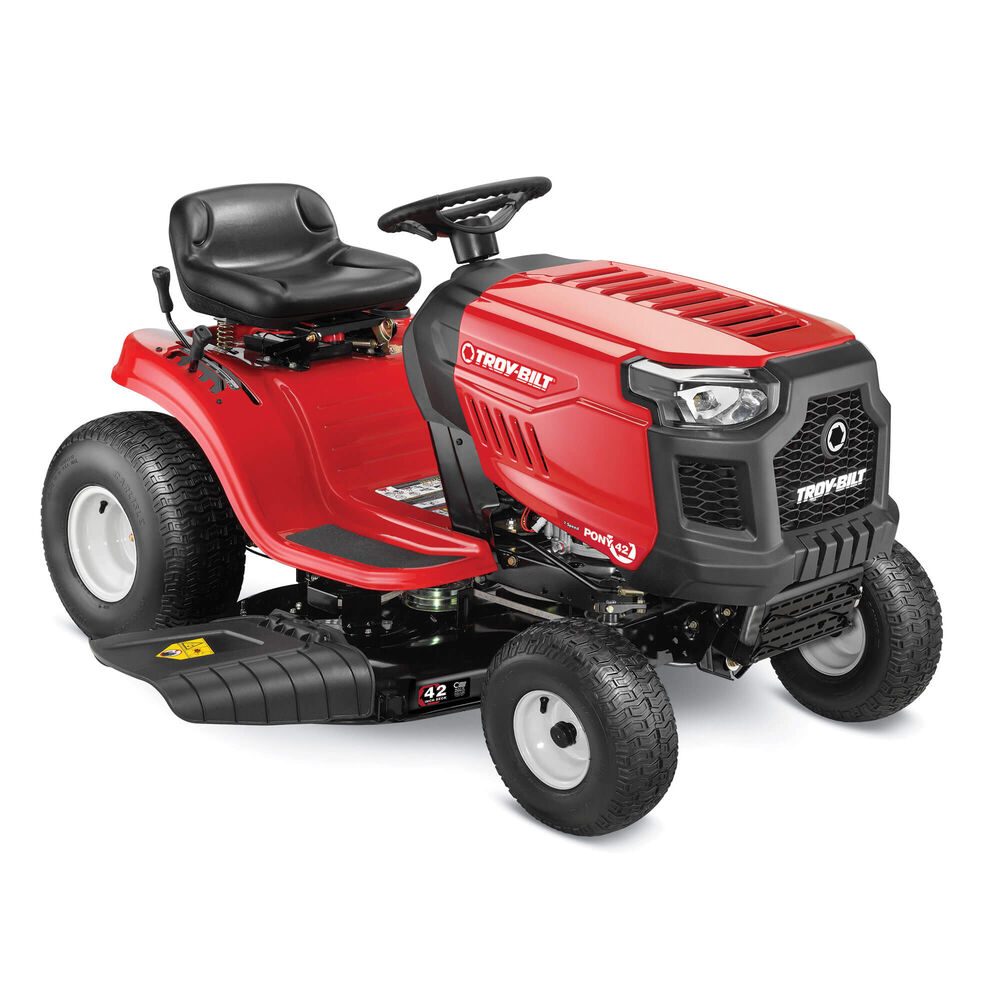
The Troy-Bilt Pony 42 premium riding lawn mower is a great option for people who do not very regularly need to mow their 1-acre lawn. If you are looking for a versatile and convenient performer, this model could be ideal for you. This one is a great mower for Zoysia grass.
It offers an adjustable cutting height that allows you to cut your lawn to your exact needs. It also features an adjustable bucket seat and aligned controls which makes it very easy to use. The compact model is the easiest to store of any of the Troy-Bilt models due to its compact size.
It does not require too much maintenance, and it is a very durable pick. Its smaller fuel capacity might mean a few more refueling breaks than other mowers, but the value of the model still holds.
Pros
- Adjustable cutting height
- Easy to use and control
- Adjustable seat for added comfort
- Easiest to store
Cons
- Smaller cutting width
What should the best riding mower offer?
Riding mowers are a great choice for tackling larger yards easily. They will deliver very professional results with minimal effort, and usually, pack an impressive range of features. If you are looking for an ideal riding mower, here are some of the things you may consider.
Engine rating
Your HP, or horsepower, will generally point to the output capacity of your mower. Models with a higher HP rating may deliver a more powerful output than lower-rated models. The power output will usually be shared between the mower’s different components, including the transmission and cutting aspects.
If you have limited HP, your mower may fail to perform to your expectations. Due to the power requirements of the different tasks, we would recommend a mower with at least an 18.5 HP rating for an ideal performance on your 1-acre lawn. If you are considering making any attachments to your riding mower, you should consider models with an even higher rating.
Cutting width
The cutting width of any mower is directly related to its output. If you have a 1-acre lawn to mow, a model with a 52″ cutting width will offer up to 50% more efficiency in cutting speed than a 32″ model would.
A model with a larger cutting surface will be better suited for larger and more even lawns, while smaller models will be ideal for compact spaces and those requiring precision cutting. If your lawn has trees and other obstacles, a model with a larger cutting width might also be more likely to experience blade damage. Also, be sure that you blades are sharpened on a regular basis. Using these recommended blade sharpeners will help.
Fuel capacity
Your fuel tank will determine the consistency of output and may play a part in determining how long you can mow without having to take a break to refuel your mower. Mowers with a large fuel capacity will need to be refueled after lengthy use, which makes them better suited for heavy-duty work on larger lawns.
Smaller capacity mowers can be problematic when it comes to very large yards, but they are very fuel-efficient for smaller spaces. Finding a model with the fuel capacity to tackle your lawn will be key to an efficient mowing experience.
The transmission
The transmission will deliver power from the engine to your wheels, allowing for control. Without the transmission, your mower will not be able to move forward or in reverse. There are three options available, each with its own benefits and drawbacks.
Manual transformers can be tougher to shift without a clutch when moving, but most models with this type of transmission are more budget-friendly than others. Automatic transmission will allow you to power your drive with a gas pedal, similar to cars. It can offer easier control, especially when obstacles are involved.
The hydrostatic transmission will be similar to an automatic transmission but uses fluid systems instead of oiled belts to deliver power. This makes them the easiest to maintain and the most seamless to drive. Understanding the right transmission for your needs will ensure you can find an easy-to-control model that is convenient for you.
Final word
The Husqvarna YTH18542 riding mower is hard to beat as the standout model for the best riding mower for 1-acre lawns. This impressive mower delivers great output and power, thanks to its specialized engine.
It is a tough build that will offer years of service, and which requires minimal maintenance. The model features a sufficient fuel tank and a great consumption rate, which means it will be a great pick for effective consumption. Its rear differential wheels offer improved traction, which ensures better control. This is in combination with the very well-designed driver layout. With this mower, you will be able to keep your lawn looking professional with minimal fuss every time.
Comparison table
| lawn mower type | Cutting width (inches) | check price |
|---|---|---|
  | 48 | Check Price |
  | 30 | Check Price |
  | 54 | Check Price |
  | 42 | Check Price |
